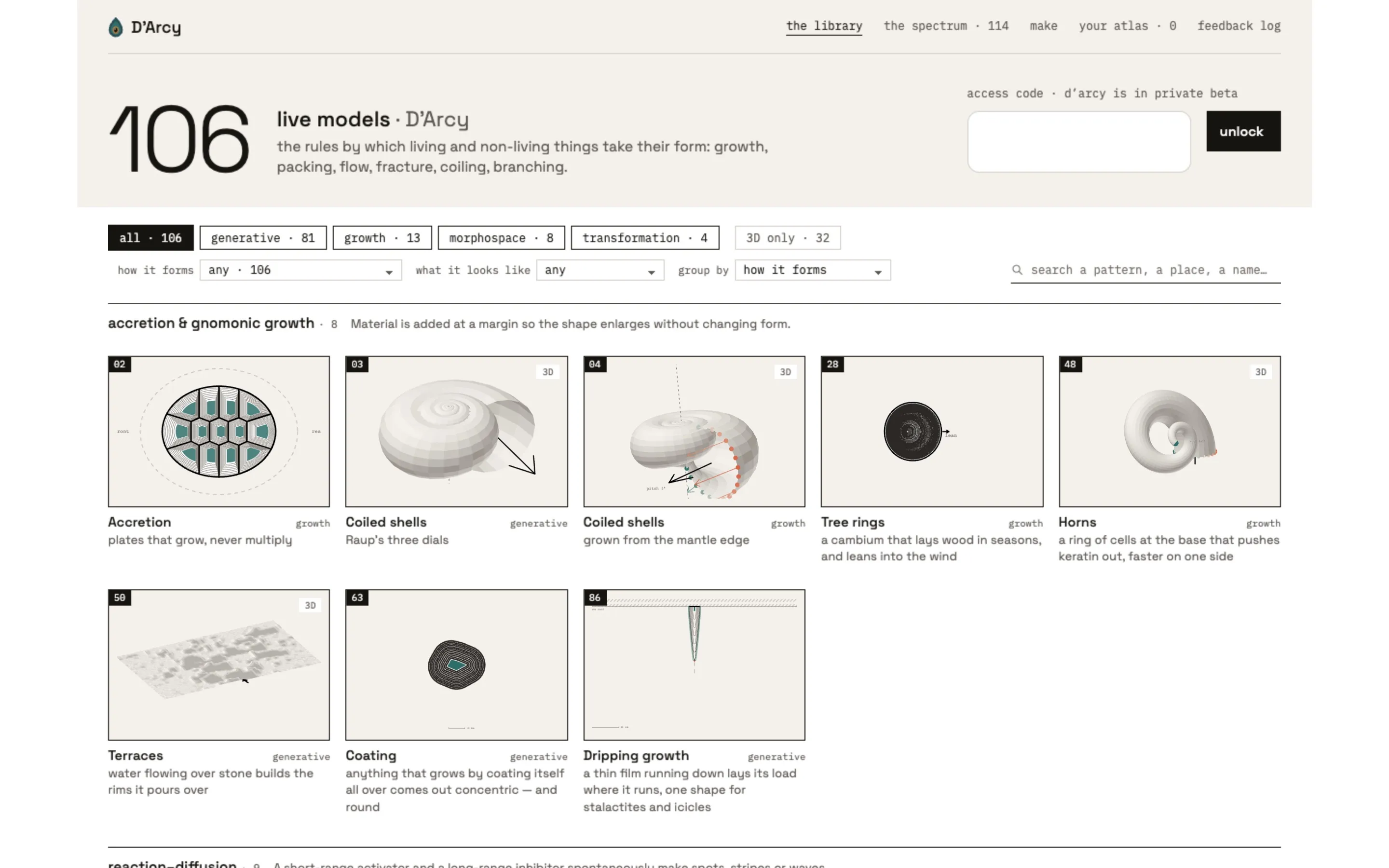
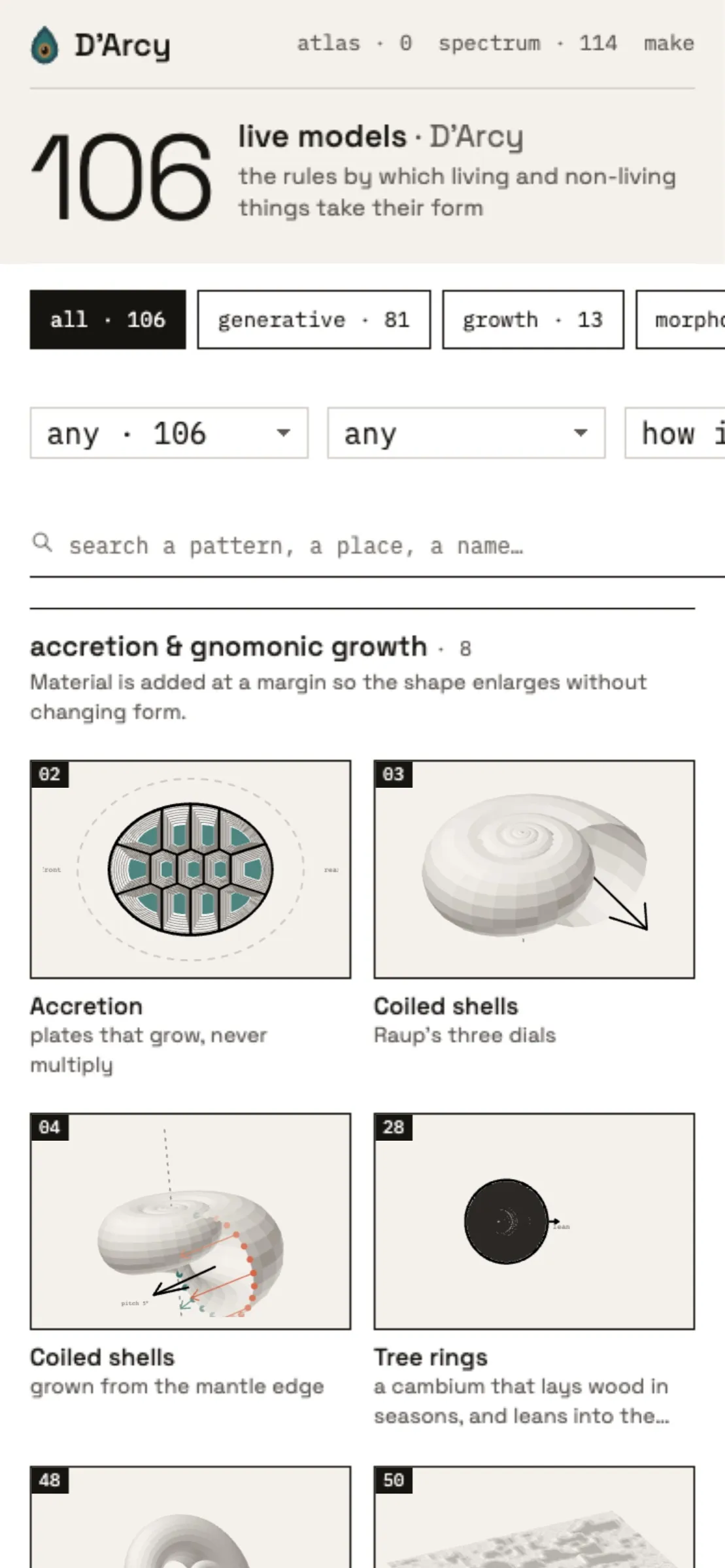
A library of 106 live models of how patterns form — shells, cracks, foam, branching. Move the dials and watch the drawing follow.
what it is.
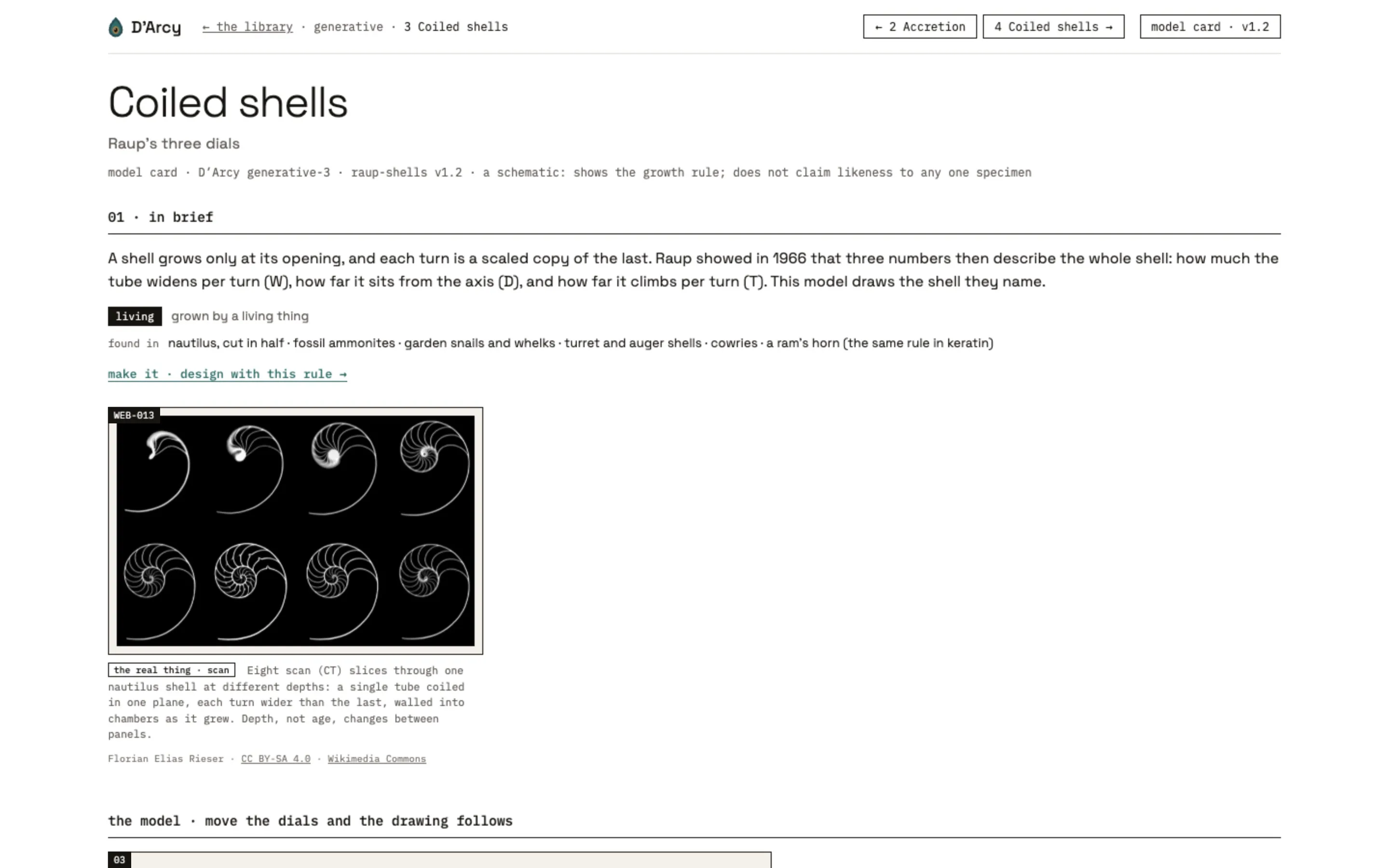
D’Arcy is our pattern library. Slats, cells, grids, spirals, cracks, foam: the forms that repeat in shells, timber, cities and joinery. Each one is a live model — the rule behind the pattern, drawn by code, with dials you can move. It’s named for D’Arcy Wentworth Thompson, who read growth and form as geometry.
We built it because the same few patterns keep turning up in our work, and once you can see them, you can design with them. It’s honest about what it knows. Every model is a schematic: it shows the growth rule and doesn’t claim to look like any one specimen. Resemblance is not mechanism.
where we use it.
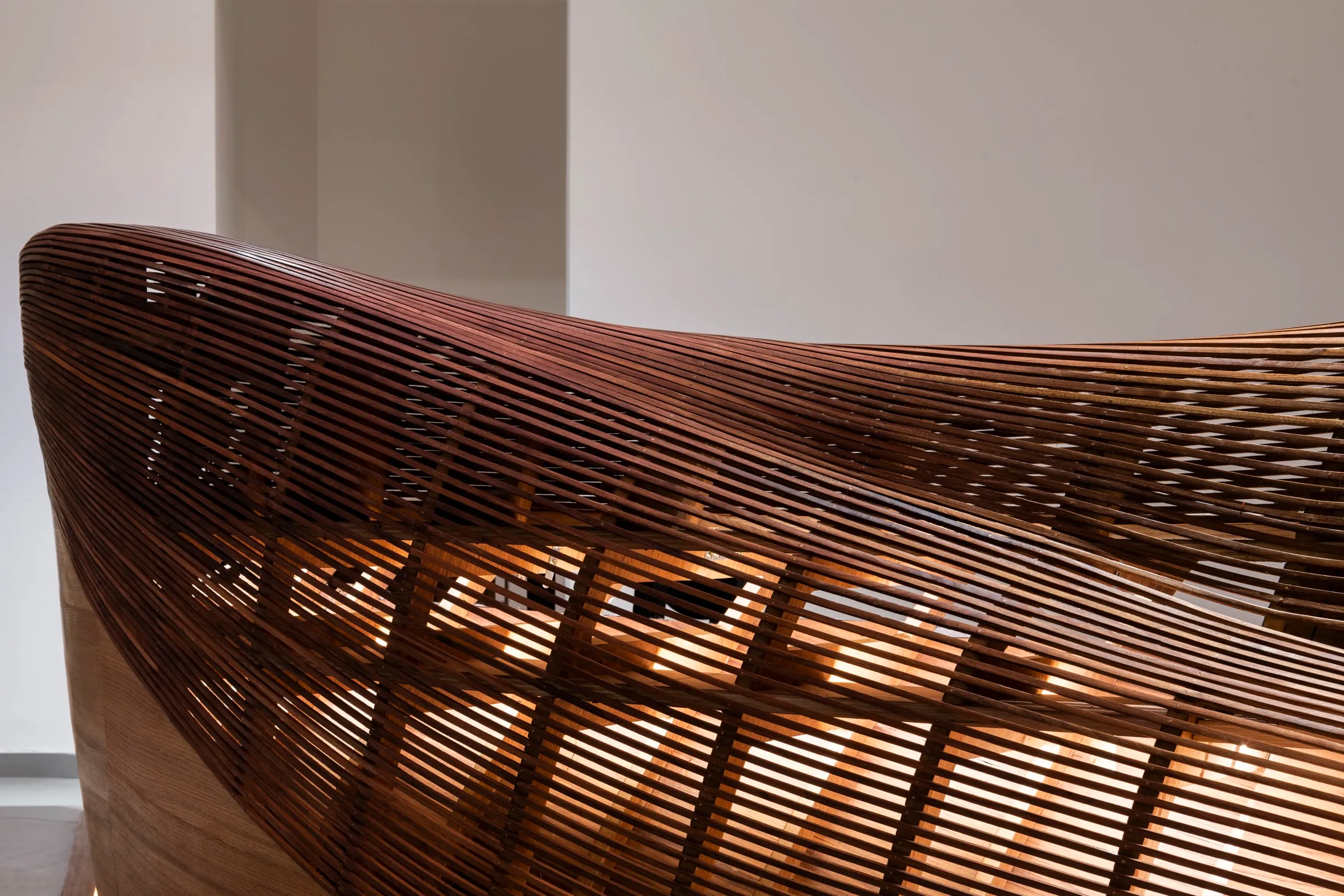
Reading our own work. The same patterns run through things we’ve made: steam-bent walnut slats on the Spinola reception desk, the library wall grid at Kikka Home, the hexagonal cells of Made to Grow, the porous clay of Sikka’s reef modules. D’Arcy gives them names, and every project page on this site carries a line naming the pattern it shares.
what it doesn’t do.
- It doesn’t make things up. Models are written once by hand, tested and labelled. If a pattern has no model yet, it says so.
- No portraits. Every model is a schematic, never a likeness of one shell or one leaf.
- No golden-ratio numerology. If something only looks like a pattern, the card says that too.
- It isn’t in Grasshopper yet. For now the geometry leaves as SVG or JSON.
- It isn’t finished. Most cards are still waiting for their review with us.
- It doesn’t follow you. Location is off, and what you save stays on your device.
what’s next.
- Open on our own website, with one email address everywhere else.
- Project pages linked to the one or two models they actually share.
- Into Grasshopper: first a live link to the library, then a Python version of each model for Rhino.
- Onto Rejig: a pattern from D’Arcy filling a panel in our wall configurator.
d’arcy, up close.