
jimm.
JIMM is our own system for designing, pricing and making joinery from one set of rules. It does for joinery what BIM does for buildings: the drawing, the quote and the machine all read from one model, so they always agree.
what it is.
At its heart is an engine that knows how we build: carcasses, fronts, drawers, joints and edging. It builds every part of a piece of joinery, prices it, nests the parts onto sheets and writes the programs and part labels for our CNC. Every tool we use sits on that one engine.
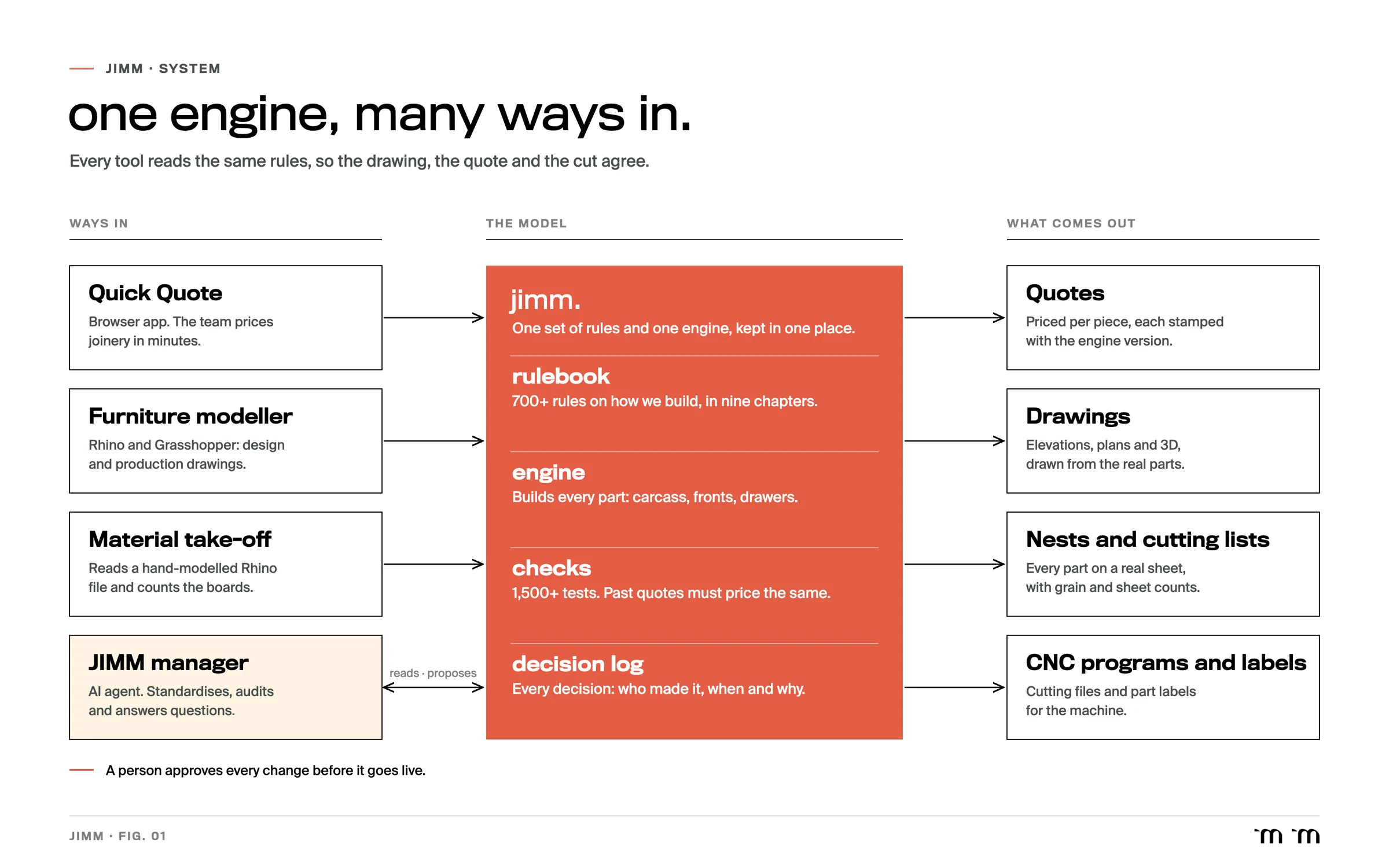
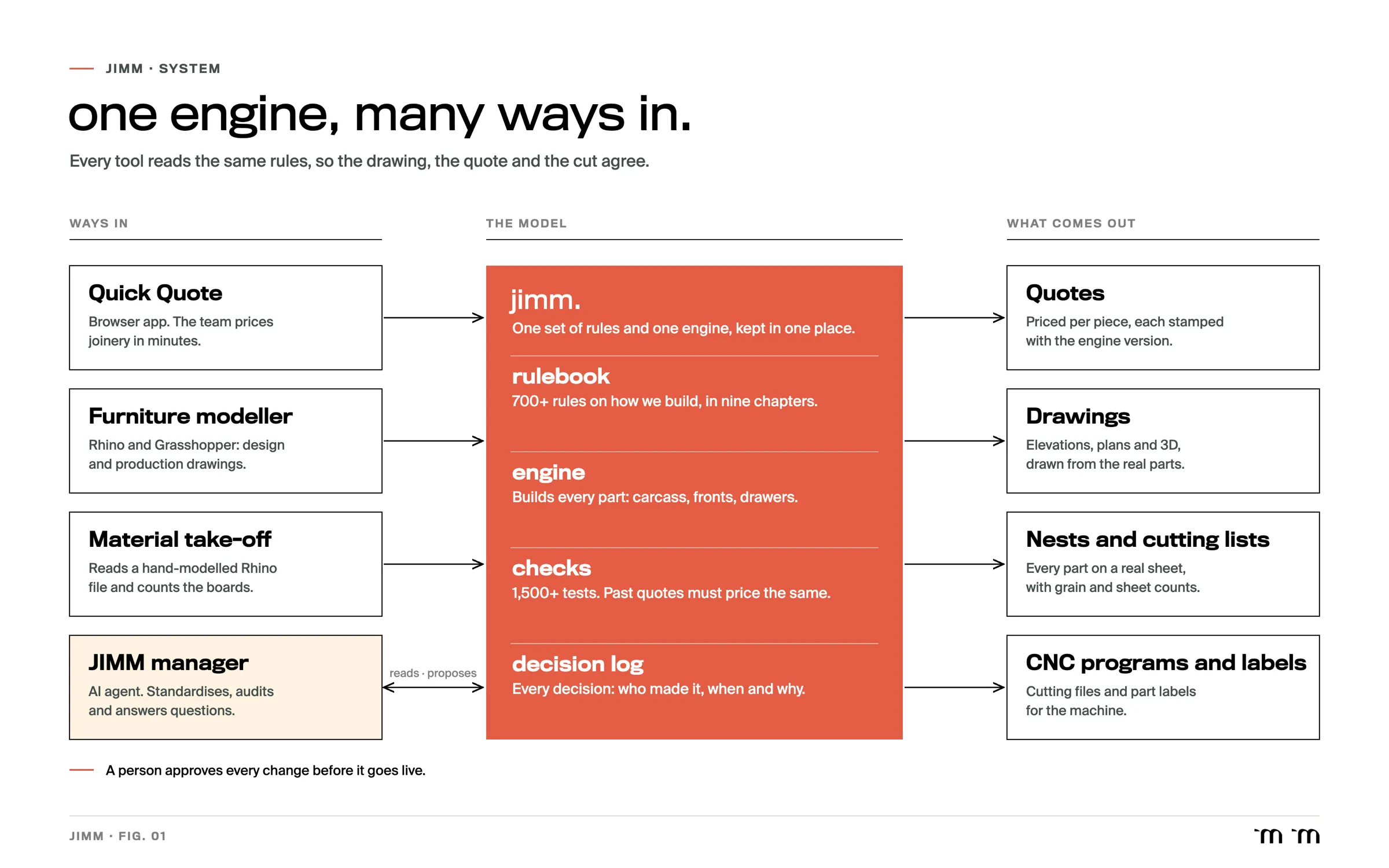 One engine, many ways in. Quick Quote, the Rhino modeller, the material take-off and the JIMM manager all read the same rules, so every output agrees.
how it works.
- Describe the piece. In Quick Quote, our browser app, we pick a builder (kitchen, wardrobe, shelving, island, desk and more) and enter the piece column by column. In the studio, the engine also runs inside Rhino and Grasshopper, where we design and prepare production. It can even read a hand-modelled Rhino file and count the boards each piece needs.
- The engine builds it. Every board, joint and fitting comes from the rulebook. Nothing is drawn by hand.
- It counts and prices. The parts are nested onto real sheet sizes, with the grain, to give the sheet count, the cutting list and the quote in minutes.
- It makes. For production, the same parts become cutting programs and part labels for the CNC.
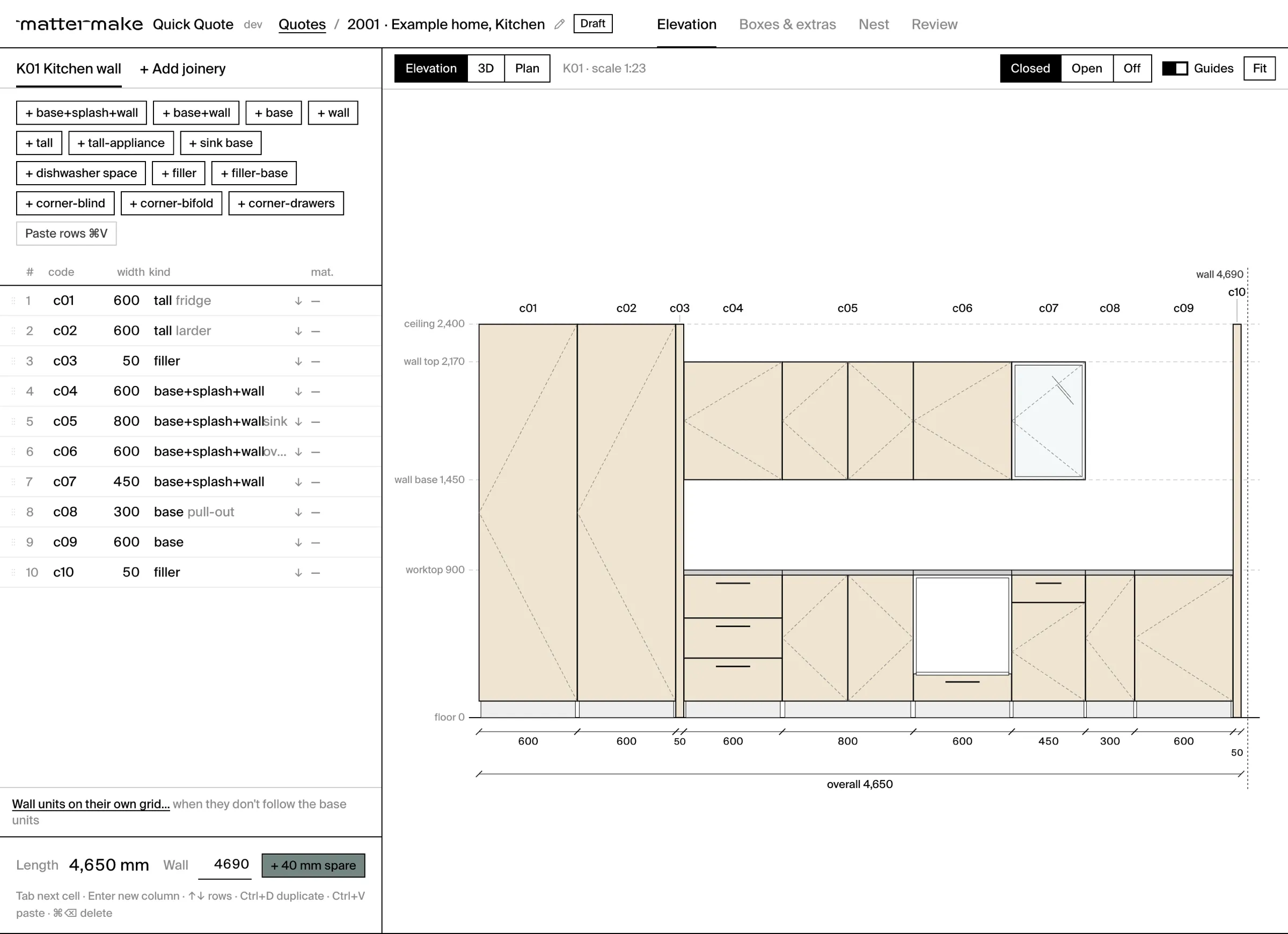 Quick Quote: a kitchen wall entered column by column and drawn to scale as we type.
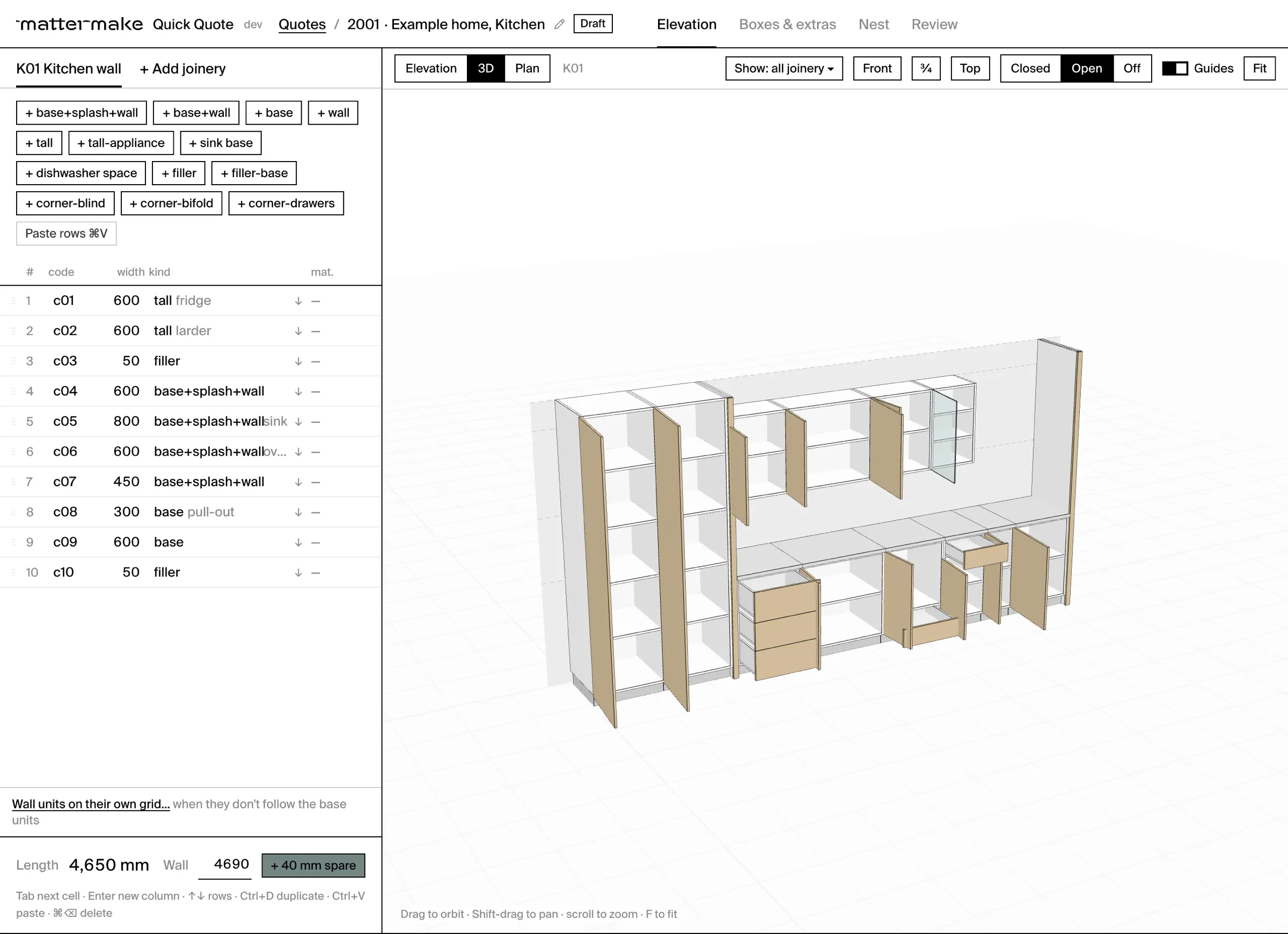 The same kitchen in 3D with its fronts open. Every board is a real part.
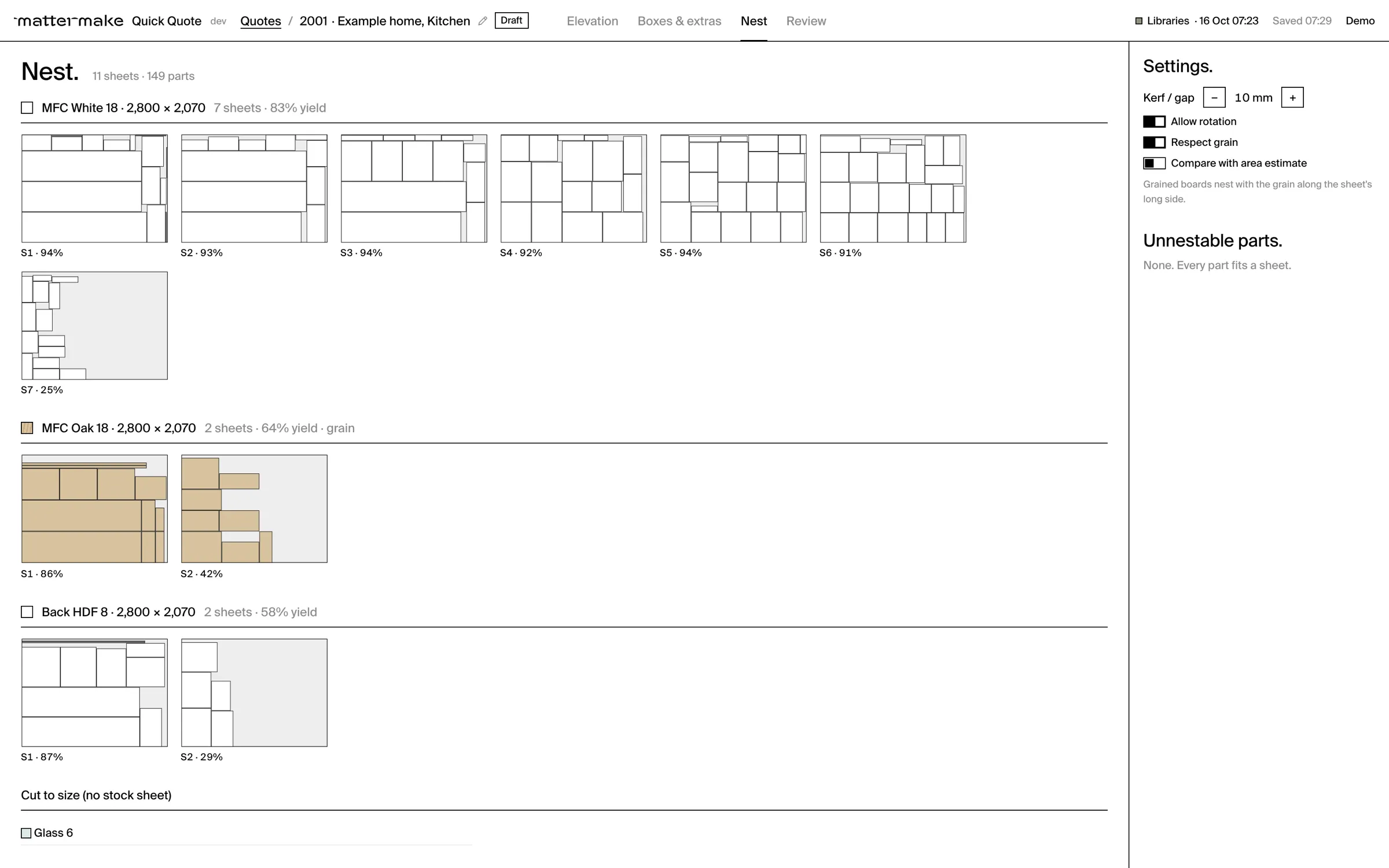 Every part nested onto real sheets, with the grain, to give the sheet count behind the quote.
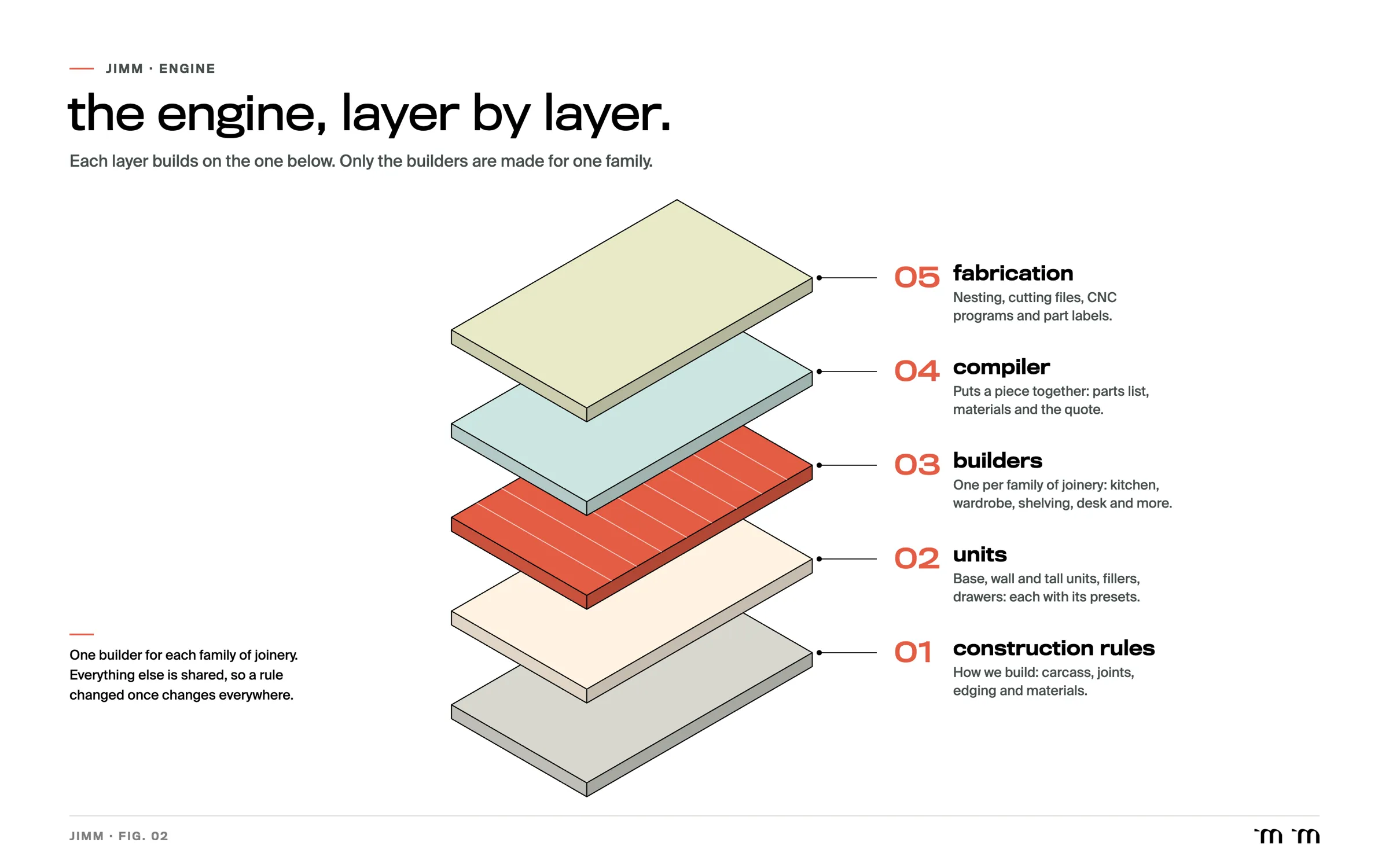 The engine, layer by layer. Shared construction rules at the base, one builder for each family of joinery, fabrication at the top.
the jimm manager.
JIMM also has a manager: an AI agent that does for our joinery standards what a BIM manager does for a building model. It turns one-off pieces into standard units, answers questions about how something was built, and audits the system every week. It proposes; a person approves.
Scripts do the exact work. The AI does the judgement and drives the scripts.
Every number on a quote and every part on the machine comes from a script.
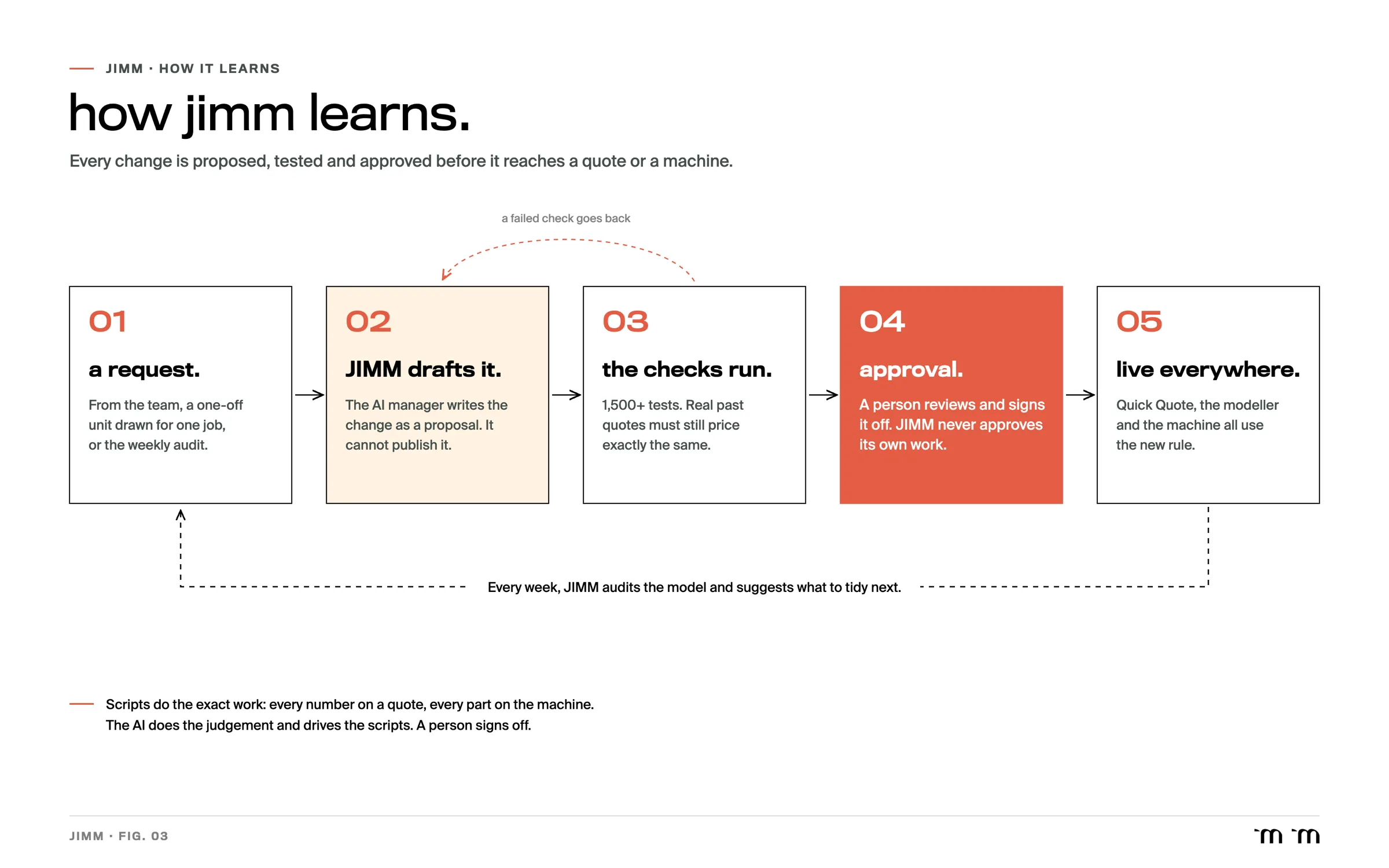 How JIMM learns. A request becomes a proposed change, the change is tested against real past quotes, and a person approves it before it goes live.
why we built it.
We are maker-architects: design and fabrication are one process for us. But our joinery knowledge lived in people’s heads and in spreadsheets, and every quote started from scratch. Between the quote and the cut, numbers drifted. JIMM writes that knowledge down as rules we can check, teach and improve.
- Faster, consistent quotes. A kitchen is priced in minutes, the same way every time.
- What we quote is what we cut. The quote and the CNC read the same parts.
- Knowledge that compounds. Every piece we make standard makes the next job quicker.
built to be trusted.
Every change is checked before it goes live: more than 1,500 automated tests, and a set of real past quotes that must still price exactly the same. Each quote carries the version of the engine that priced it.
where it stands.
Quick Quote went live for our team in October 2026. The rulebook, over 700 rules in nine chapters, is being confirmed with our workshop. The machine output is being proven on our own CNC before it cuts production parts.