
d’arcy.
D’Arcy is our pattern spotter’s field guide: a library of 106 live models of how patterns form, from shells and foam to cracks, branching and marbled paper. Each one is a rule you can play with. Move the dials and the drawing follows.
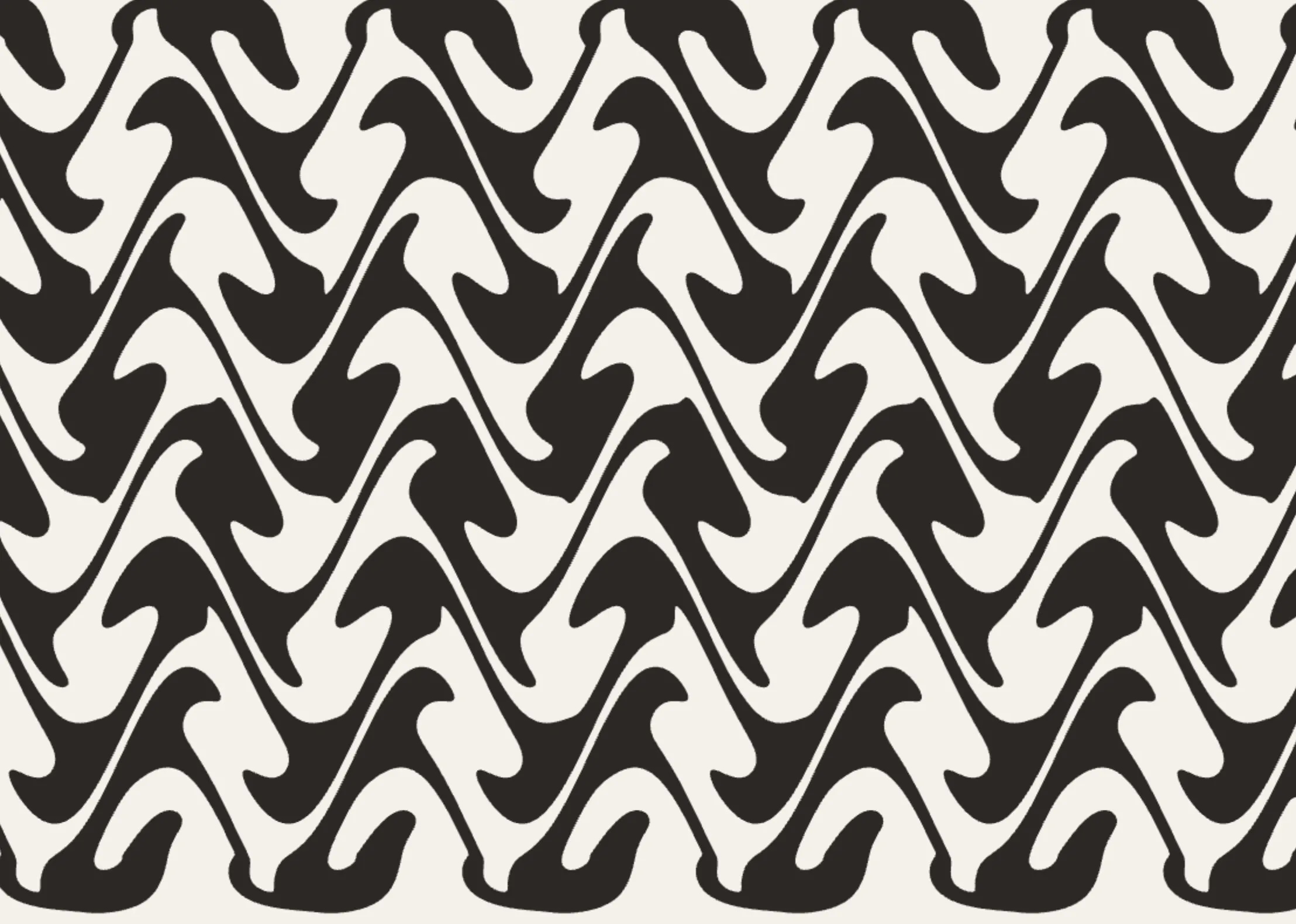
The same few patterns keep turning up in our work. Slats, cells, grids, spirals, swirls. They turn up outside it too: in shells and timber, in cracked mud, in foam, in the way a tree splits. D’Arcy is how we learn to read them.
It’s a library of live models. Each one is the rule behind a pattern, written in code, with dials you can move. Coiled shells, tree rings, foam, cracks, convection, a hanging chain, a honeycomb, a marbling tray. We started it in August 2026, and by the end of September it held 106 models, 32 of them in 3D.
why d’arcy.
It’s named for D’Arcy Wentworth Thompson, who read growth and form as geometry. His book, On Growth and Form, came out in 1917, and it’s the library’s founding text. Two of his ideas have models of their own: his grids, which stretch the drawing of one fish into another, and his argument that a honeycomb is hexagonal because of the wax, not because the bee measures an angle.
That’s the spirit we wanted. Not a gallery of pretty shapes, but the rule underneath each one, so you can see why it looks the way it does. Once you can see a pattern, you can design with it.
what’s in it.
Open the library and you get 106 cards, grouped by how they form: accretion, packing, fracture, erosion, crystallisation, reaction–diffusion and more. Or sort them by what they look like: spirals, cells, stripes, cracks, folds, meanders. Show only the 3D ones, or search a pattern, a place or a name.
Most models grow something. A few are maps instead: every egg shape on one plane, with real birds plotted on it, or Raup’s cube of coiled shells, with real shells placed inside.
Open a card and it starts with the rule in brief, where the pattern turns up, and a photograph or scan of the real thing. Then the model: move the dials and the drawing follows. Drag a 3D one to turn it. Presets set the dials to real specimens: a beech, a Norway spruce and a cast of a lung on the branching model, brain coral and cauliflower coral on the coral one.
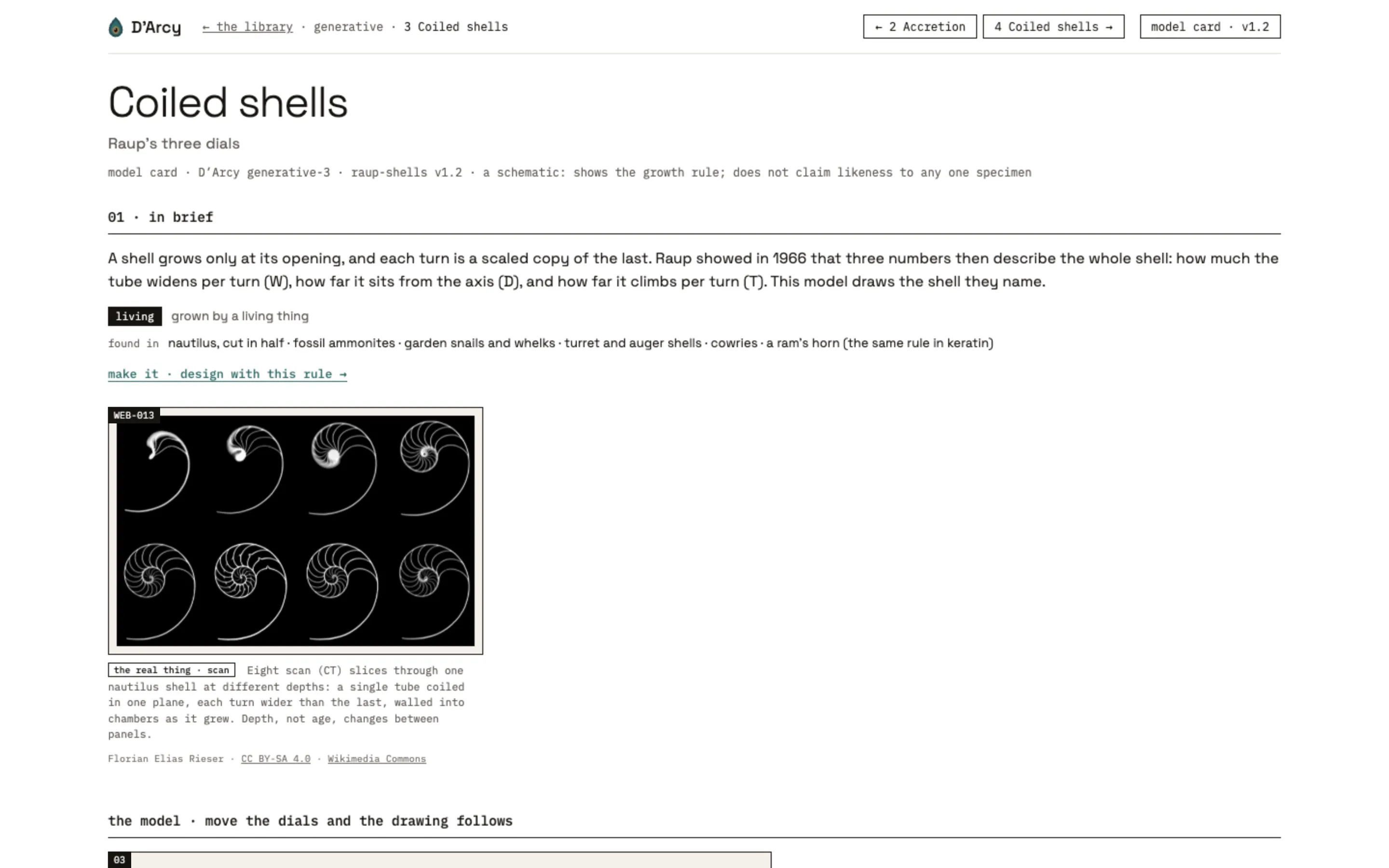 A model card · coiled shells. The rule first, then the real thing: CT slices through one nautilus.
Every number on a card is measured off the drawing, or it carries an EST tag because it’s an estimate. The two never merge. Then you can take it away: the drawing as an SVG with each part on its own layer, ready for CAD, or the geometry as JSON.
Behind the 106 sits a bigger map, the spectrum: 114 named patterns, grouped by form and by mechanism. If a pattern has no model yet, D’Arcy says so rather than fake one.
Two of the models sit close to our essay on regional tectonics. Convection is the Bénard cells it starts from: heat a thin layer and it breaks into cells the size of its depth. Mound breathing is a termite mound of the kind Scott Turner read as a machine, its air moved by the sun’s daily swing.
where we use it.
On this site, six project pages link straight to the model they share. We only linked where the pattern really is the project’s. None of them was designed with D’Arcy. Not yet: most are older than it, so it reads them after the fact. That’s still worth doing: once a pattern has a name and a rule, it’s easier to use on purpose next time.
Le mur fondante and Manouche. The wall in Manouche’s window in St Julian’s is solid walnut, milled on the CNC, then carved, sanded and varnished until it looked like melted chocolate. It’s the same move as stirring chocolate or combing a marbling tray. In the stretch and fold model, every stir makes the boundary between two colours longer. The colours never blend, they interleave.
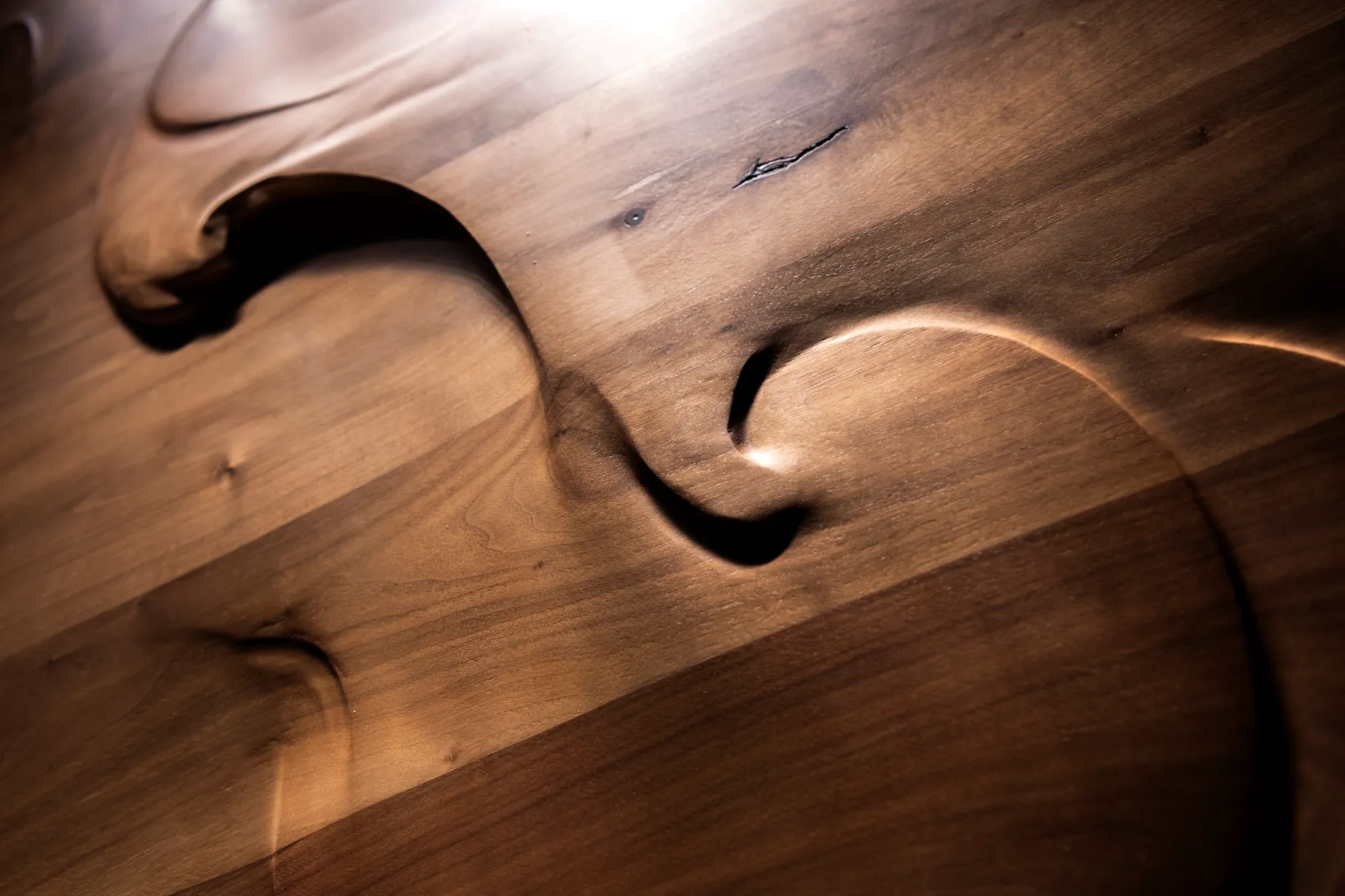 Le mur fondante · Manouche, St Julian’s · carved American walnut.
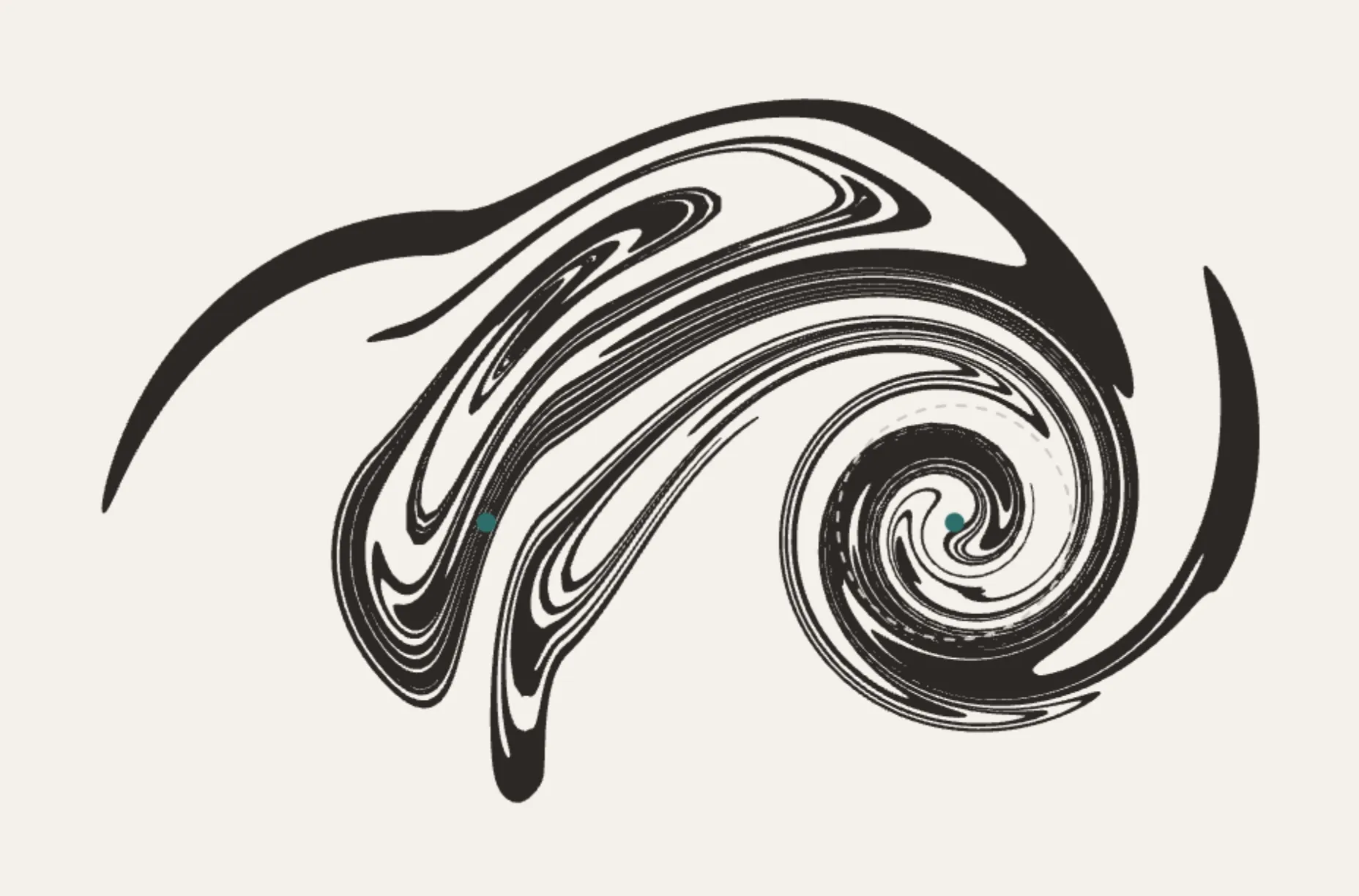 The same move in D’Arcy · stretch and fold, blinking vortex. Two stirrers take turns, six stirs in all, and the boundary comes out 55 times longer.
The MDW 2014 pavilion. A 5 m parabolic vault of 413 CNC-cut plywood panels at Fort St Elmo, with no fixings: every panel holds up its neighbours. The funicular model hangs a chain and turns it over, and you have the arch that carries itself. It also draws the parabola through the same three points, so you can see how little the two curves differ. The vault itself was modelled in Rhino, twelve years before D’Arcy existed.
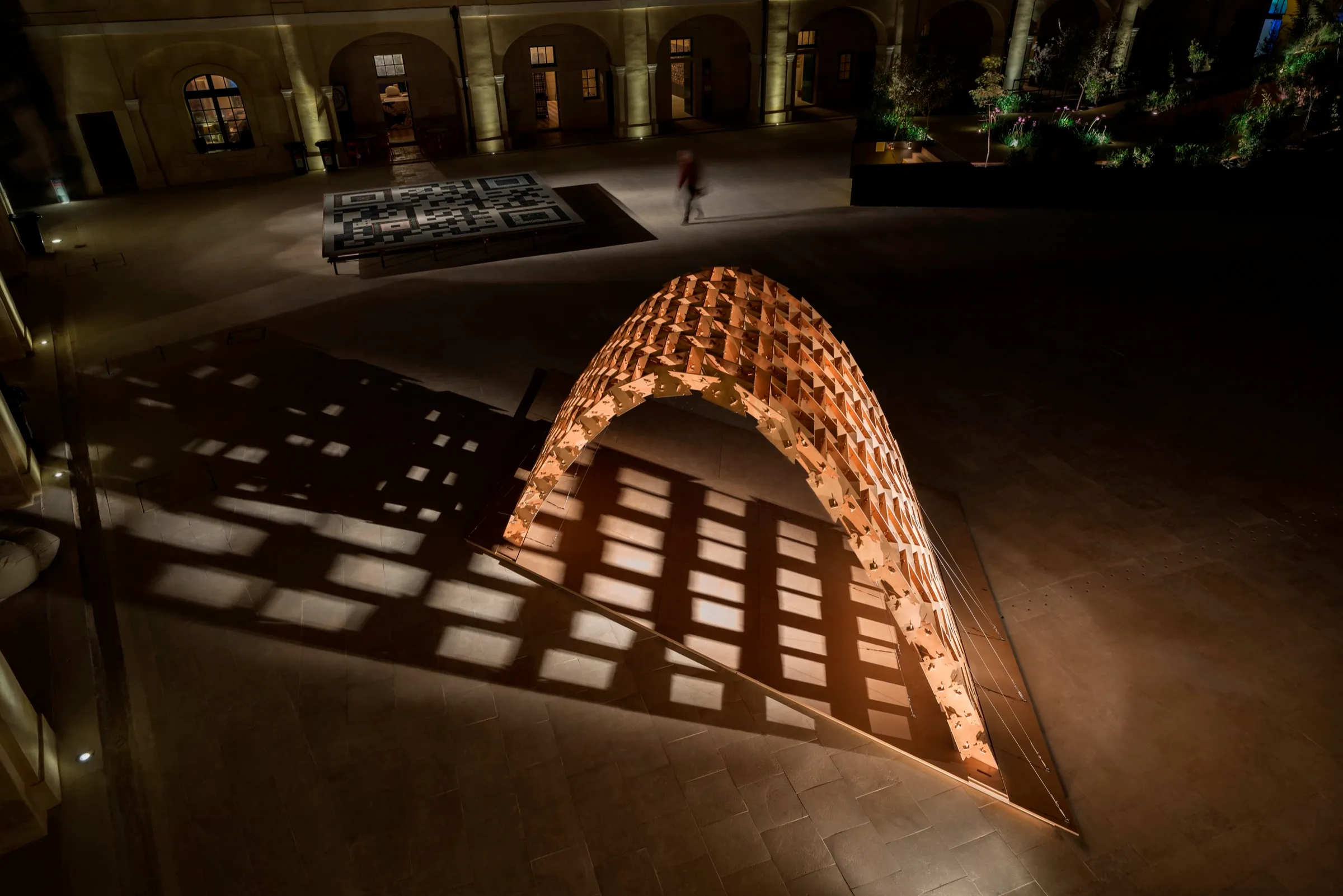 MDW 2014 pavilion · Fort St Elmo, Valletta · photo Alex Attard.
Pearl, Arkadia. The tree in the middle of the shop was modelled in Grasshopper and cut on our robotic arm. The branching model is what a real tree does: one split, repeated. One of its presets is Murray’s law, the rule blood vessels and airways follow.
Made to Grow. Our modular timber school system is set out on a hexagonal grid. The warm wax model shows why a honeycomb ends up hexagonal: the bee builds a round tube to her own width, and the warm wax between touching tubes flows flat. Our grid was a choice. The comb’s is physics. D’Arcy keeps the two apart, and so do we.
Sikka. Our reefs are meant to give marine life somewhere to start. The coral model grows a colony toward the light and the current that feed it. It helps us think about what we’re asking the sea to do. It isn’t a forecast of what will settle.
On how we design, D’Arcy is the tool behind pattern grammars: slats, cells, grids, spirals. Its make page is the start of designing with it: pick a model, and it draws variants, each measured off its own drawing.
what it doesn’t do.
Resemblance is not mechanism.
- It doesn’t make things up. Each model is written once by hand, tested and labelled. Nothing is generated on the fly.
- No portraits. Every model is a schematic: it shows the growth rule, not a likeness of one shell or one leaf. If two things only look alike, the card says so. No golden-ratio numerology.
- It isn’t engineering. A model is a rule, not a structural result. The hanging chain has no thickness, so it shows the line of thrust moving, not whether a real arch survives it. The make page says what a real material and size would still need tested.
- It isn’t in Grasshopper yet. For now the geometry leaves as SVG or JSON.
- It isn’t finished. Quite a few cards are still waiting for their review with us.
- It doesn’t follow you. Location is off, and what you save stays on your device.
what’s next.
Into Grasshopper: first a live link to the library, then a Python version of each model for Rhino. Onto Rejig, our wall configurator, with a pattern from D’Arcy filling a panel. And open on our own website, with one email address everywhere else.
try it.
D’Arcy is free at darcy.mattermake.com. On its own site it may ask for an email address, never a password. Pick a model and move a dial. Then go and find the pattern out in the world: in a cracked wall, a slice of tree, the foam on your coffee.
If a pattern in your project needs a rule behind it, we should talk.