
One home for the studio’s tools. Sign-in, projects, quotes, money and mail join up on one page, built role by role.
what it is.
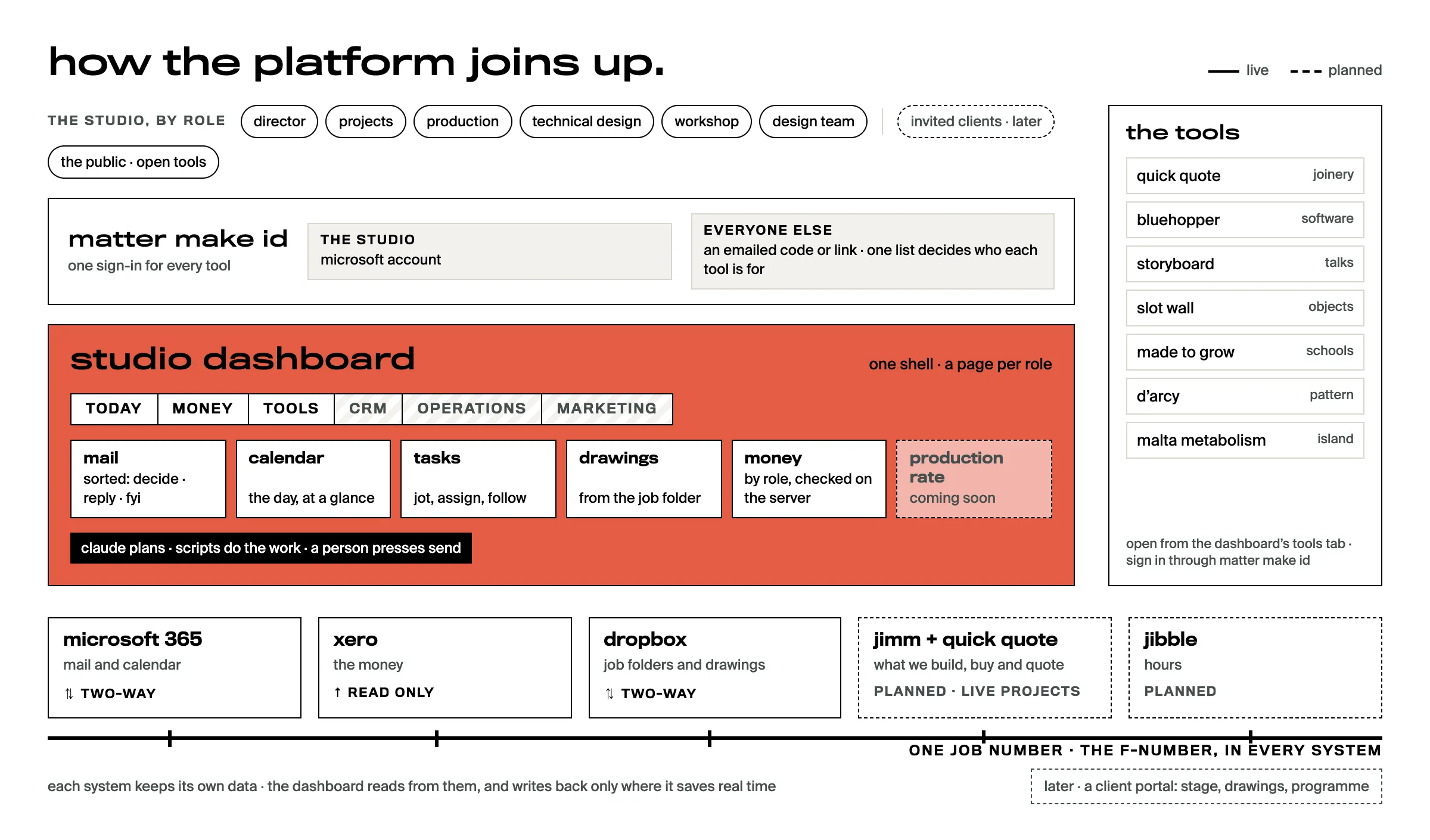
We’ve built a lot of our own tools: JIMM for joinery, Quick Quote, BlueHopper, Storyboard, D’Arcy, Gamut. Each one solved a real problem. Each one also added another place to look. The studio dashboard turns that around. It’s one home where each of us opens one page and finds what our job needs, and where the tools become parts of one platform, fed from shared data.
It doesn’t replace the systems we already run. Xero keeps the money, Microsoft 365 keeps mail and calendar, Dropbox keeps the project folders, JIMM keeps what we build and buy. The dashboard reads from them, and writes back only where that saves real time. What ties it together is one job number: the same F-number in every system, created once when a project starts.
where we use it.
It’s live in the studio, starting with the director’s page. That page sorts the day’s mail, shows the calendar and the tasks, and puts the money on one screen.
Some of the small things matter most. You type the gist of an email and Claude writes it, finds the people and attaches the right files. You ask for the latest drawing of a job and it’s found in the job’s folder. A task can be jotted down on a phone in one line, or handed to a colleague. Every email sent from the dashboard is filed with the job, attachments and all.
The pages for the other roles are being built now.
what it doesn’t do.
- It replaces none of our systems. Xero, Microsoft 365, Dropbox and JIMM keep their own data.
- It doesn’t write to Xero. The money side only reads.
- It isn’t public, and it isn’t a product. It’s built for one small studio.
- Not everything is connected yet. Hours aren’t in, so the production rate still says coming soon, and any card still on sample data is greyed out, so nobody mistakes a made-up number for a real one.
- A dashboard magnifies bad data. A number on screen is only as good as the habit that feeds it, which is why the job number came first.
what’s next.
- Home pages for the other roles.
- Hours, for resourcing and the production rate.
- JIMM for live projects, so quotes and tenders come mostly from the model instead of by hand.
- A client list inside the dashboard, and a proposal app that reads from it.
- Later, a portal for invited clients: the project’s stage, issued drawings, the programme, showing only what’s marked for them.
- The staff tools signing in through Matter Make ID, one at a time.