
we make what matters.
Why a small Maltese studio does what it does, and how we work a project out: from the people and the place, through computation, to the workshop and back.
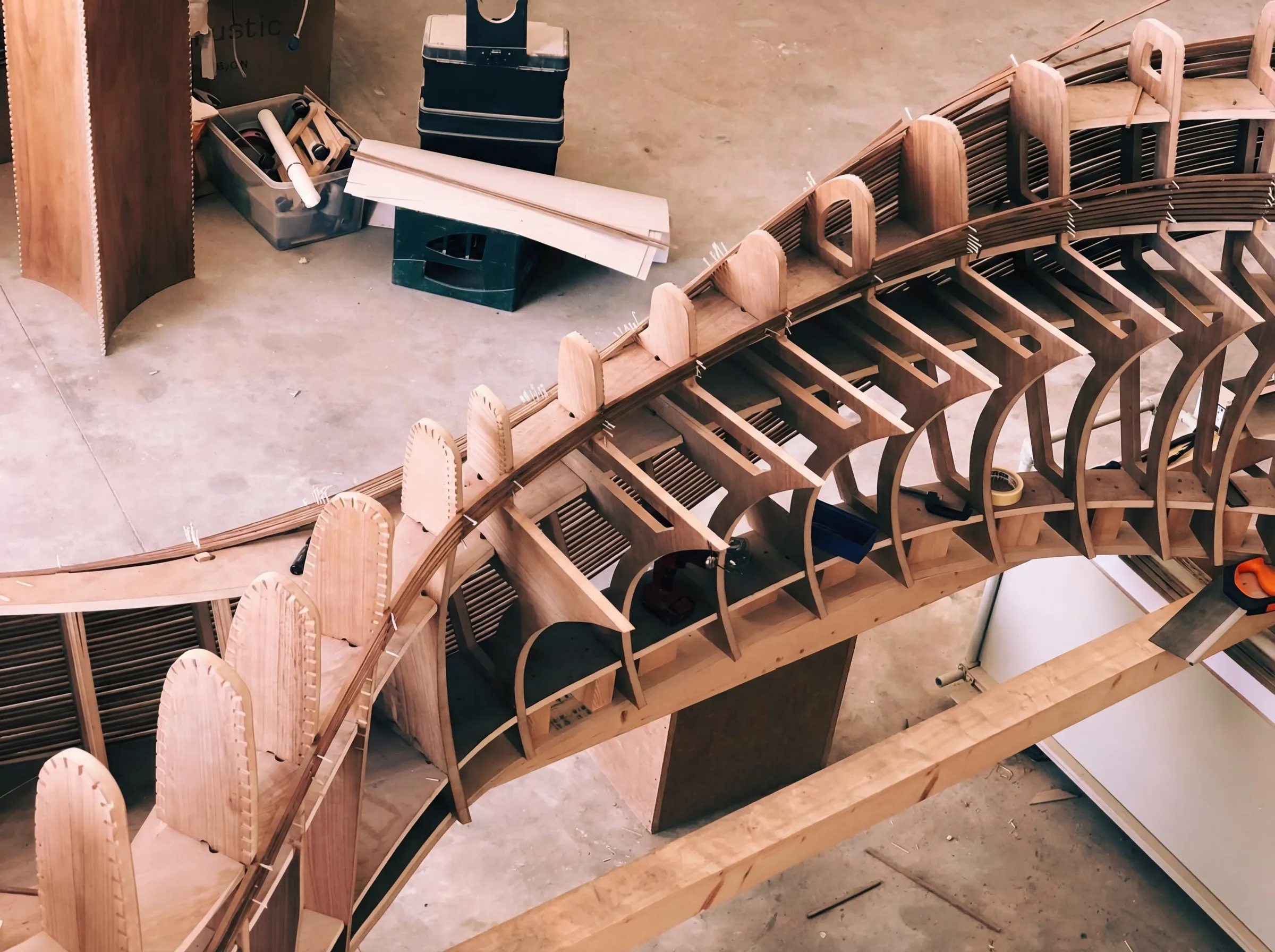
We are a small Maltese studio. We design buildings, fit-outs, joinery and the careful, ordinary things people ask of a studio like ours. That work is where we come from. It keeps teaching us. We are proud of it.
Alongside it, we have been pulling on a thread we cannot quite let go of. It comes down to something simple: we want to design more carefully for the way energy and life actually move through the things we make.
A wall is not just a wall. A façade is not a finish. A reef on the seabed is not a sculpture. Each is a layer between people and place, between living things and the world they have to live in. We want to design those layers on purpose.
we start most things naïve, on purpose.
We let ourselves ask the naïve question first — what is this for, what does it want to do — before experience or convention crowd the answer. It is how a small studio earns its place in work it has not done before. It is also how we keep enjoying the work we have done many times.
What we cannot reach with our knowledge or experience, we reach with our imagination. And then our curiosity bridges the gap.
That is our ethos, and if we are honest it is how we have always been. We are people who, once we have imagined a thing, will break our heads against a wall to understand how it works. We love the wall. We love the breaking.
The bridge is curiosity, and the toolset is craft. Systemic design and design thinking gave us a way to handle the wild idea once we have hold of it — to take it apart, weigh its parameters against each other, and turn the shooting star we caught last night into something we can build on a Monday morning.
We are good at this part. Visualising, categorising, weighting multi-objective problems, then making — these are the muscles we have built over years of practice. They are what gets a project from imagination to something you can stand inside, sit on, or dive on. We trust them. They are why we can let imagination run ahead in the first place.
making as thinking.
Making is how we think a thing through. It is also how we show care. We are not here to add decoration to a world that has too much of it. We are here to be useful, in specific places, to specific people, for specific reasons. We design and make things so that the people who use them have a better day because we did.
Some of what we make is a kitchen, or a piece of joinery for a family home. Some, like Cinema Visiona, is a home cinema where the seating becomes a landscape and the body is invited to find its own way of sitting. Some, like Made to Grow, is a modular system for early-years schools — where the architecture itself is meant to teach, and where the schoolyard does as much of the work as the classroom. Some, lately, is a piece of architecture for the seabed — built to host marine life that has nowhere else to go. The scale and the audience change. The intention does not.
we are not finished, and we are not pretending to be.
The thinking we have just described is still finding its full shape. The studio still does plenty of work that does not lead with it. We do not have all the answers, and we will not have them tomorrow. The point is not to arrive. The point is to keep starting naïve, keep asking the naïve question, keep letting imagination outrun our experience — and to keep using curiosity and craft to catch up to it.
Two projects are testing this most clearly at the moment. Made to Grow, our modular system for early-years learning, has to perform under the gaze of children — a school either lets them flourish or it does not. Sikka, our marine R&D programme, has to perform underwater — a reef either hosts life or it does not. The seabed and the schoolyard are not as far apart as they sound. They are different scales of the same care.
what we promise.
We will keep listening to the work. We will keep choosing care over cleverness. We will keep collaborating with people who know more than we do about marine life, about science, about communities, about craft. We will keep making things, locally, with our hands and our tools, so that the leap from a drawing to a built thing stays short. We will keep being naïve at the start of a question, and careful at the end of one.
We make what matters.
— Matter Make
how we design.
The manifesto says why. This part says how. We call it a methodology, though it isn’t a sequence of steps. It’s a set of ways of working that we pick from for each project.
We bring together human-centred design, systems thinking, computation and hands-on material experiments. Some of the work runs top-down, from an idea outwards. Some runs bottom-up, from what we find while sketching, making models, writing code and cutting parts in the workshop. For us, design and making aren’t separate stages. They are one loop: people, ideas, materials, machines and the place itself keep changing each other as we go.
three kinds of intelligence.
- Human: empathy, creativity, intuition and critical judgement.
- Computational: algorithms, associative relationships, parametric systems, simulation, optimisation and generative processes.
- Material: physical behaviour, material properties, fabrication constraints, emergent geometries and tectonic systems.
six modes of practice.
- Understand. People, context, needs and opportunities. We get to know the people and circumstances that give a brief its meaning, and reframe the brief before committing to an answer. Design research, co-design, contextual inquiry, problem framing.
- Map. Systems, relationships and wider impact. We trace how people, materials, processes, places and scales depend on each other, and make those links legible. Systems mapping, multi-scalar thinking, circular and regenerative design.
- Explore. Ideas, materials and other possibilities. We move between top-down intentions and bottom-up discovery, and use sketches, models and scenarios to open up options rather than close them too soon. Sketching, model-making, material-first exploration, scenarios.
- Compute. Modelling, simulation and design intelligence. We put relationships, constraints and performance into computational models that can generate, test and refine what we’re designing. Parametric and generative design, simulation, form-finding.
- Make. Prototyping, fabrication and learning through making. Making is a way of asking questions: materials, tools and the way things go together get a say in the design. Robotic craft, prototypes as inquiry, design for manufacture and assembly.
- Evolve. Testing, evaluation and getting better. Feedback from prototypes, people, performance and use tests our assumptions and points the next round of design. Testing, feedback loops, post-occupancy learning, lifecycle thinking.
It isn’t a line from one to six. We go round, back and across: explore, test, refine, reframe.
from intelligence to impact.
The same ways of working hold at every scale: from how a material behaves, to the geometry of one part, to a product, a whole building, and what it all does to the place and the community around it.
a more regenerative future.
We use what people know, what computation shows us and what materials teach us, together. We want what we make to adapt over time, to be responsible in how it’s made, and to leave the places and people around it better off.
Human-centred design, design thinking, co-design and rapid prototyping are well-established approaches, associated with IDEO and the Stanford d.school. How we put them together here is our own, not an official Stanford or IDEO model.
See it at work on how we design, and in the essay on regional tectonics.